Jun 23, 2015

One night only


El lunes 22 de junio se abrió el ciclo de lecturas dramatizadas One Night only de la mano La tropa produce. La iniciativa, que es nueva en España pero que ya ha tenido considerable éxito en países anglosajones, consiste en la lectura dramatizada del guión de una película de amplio reconocimiento. En una sola noche, un grupo de actores se reúnen para realizar una especie de ensayo público en frente de espectadores que únicamente conocían la historia a través de la pantalla.

El estreno no podía ser mejor: adaptando la mítica película de Quentin Tarantino: Pulp Fiction. La cinta, estrenada en 1994 y galardonada con la Palma de Oro y el Oscar al mejor guion original, se convirtió rápidamente en todo un icono de masas, un símbolo de la postmodernidad y una seña de identidad de su aclamado director.

El encargado de dirigir la lectura dramatizada fue Carlos Vermut, gran promesa del cine español y reciente ganador de la Concha de Oro a mejor película y Concha de Plata al mejor director por la perturbadora Magical Girl, cinta que a su vez consiguió 17 nominaciones a los Goya y dos Premios Feroz. El estilo de sus películas, plagadas de diálogos un tanto surrealistas, situaciones imposibles y mucho humor negro, guarda una estrecha relación con el estilo de las de Tarantino; no es de extrañar, por tanto, que Vermut aceptase la propuesta, considerándose un fan con mayúsculas del director americano. No solo condujo la lectura, sino que además fue el narrador de la historia e interpretó el personaje de Jimmie Dimmick.

El reparto reunió a grandes estrellas de nuestro cine: José Coronado, ganador del Goya a mejor actor por No habrá paz para los malvados, quien interpretó el papel de Samuel L. Jackson, Jules Winnfield;  Jorge Sanz, un clásico del cine español por películas como Amantes o Belle Epoque, y la serie ¿Qué fue de Jorge Sanz?, quien dio vida al tierno y bravucón Vincent Vega, interpretado por el inconfundible John Travolta; Elena Anaya, camaleónica actriz donde las haya, triunfadora de los Goya por La piel que habito, quien se metió en la piel de la fiera Mia Wallace, personaje que relanzó la carrera de Uma Thurman; José Sacristán, el más veterano de todos con una amplia y exitosa carrera a sus espaldas -a destacar su reciente interpretación en Magical Girl-, quien se metió en la piel de Marsellus Wallace, interpretado originalmente por Ving Rhames; Bárbara Santa Cruz, última presentadora de los Premios Feroz y prometedora actriz de cine y televisión, quien fue Fabienne, a quien dio vida Maria de Medeiros; Sergio Peris-Mencheta, director y actor de teatro con obras como Tempestad o Lluvia Constante, y actor de cine y televisión, interpretó  a Butch Coolidge, el personaje de nuestro querido Bruce Willis; y por último, dos actores en ciernes que completaron el reparto: Teresa P. Caballero, actriz en cortos como Ausencias y Hienas, y Rodrigo Ramírez, actor en Vooyeur y protagonista del monólogo Una puta mierda.

La propuesta, que tuvo lugar en el Cine Capitol de la Gran Vía, parece sin lugar a dudas prometedora. Esperemos que triunfe por todo lo alto y que se puedan adaptar otras obras maestras como ésta en un futuro.                                                                          
Diego Martín

One night only

On Monday June 22 the cycle of dramatized readings One Night only organised by La tropa produce started. The initiative, which is new in Spain but has already had considerable success in Anglo-Saxon countries, consists on the dramatic reading of the script of a film widely recognized. In one night, a group of actors gather to make a sort of public rehearsal in front of an audience that only knew the story through the screen.

The premiere could not be better: adapting the legendary Quentin Tarantino´s film “Pulp Fiction”. The film, released in 1994 and awarded with the Palme d'Or and an Oscar for Best Original Screenplay, quickly became an mass icon, a symbol of postmodernism and a hallmark of its acclaimed director.

The responsible for leading the dramatized reading was Carlos Vermut, great promise of the Spanish cinema and recent winner of the Golden Shell for Best Film and Silver Shell for Best Director for the disturbing “Magical Girl”, a film that got 17 nominations to the Goya awards and two Feroz Awards. The style of his films, plagued with surrealistic dialogues, impossible situations and loads of black humor, is closely associated with the style of Tarantino's; it is not surprising, therefore, that Vermut accepted the proposal, considering himself a fan of the American director. He was not only leading the reading, but also narrated the story and interpreted Jimmie Dimmick's character.

The cast brings together stars of the Spanish cinema: José Coronado, Best Actor on the Goya Awards for “No Rest Gor the Wicked”, who played the role of Samuel L. Jackson, Jules Winnfield; Jorge Sanz, a classic of Spanish cinema for films such as “Lovers” or “Belle Epoque”, and the series “¿Qué Fue de Jorge Sanz?”, who played the bully and tender Vincent Vega, played by the unmistakable John Travolta; Elena Anaya, a chameleonic actress, winner of the Goya Award for “The Skin I Live In”, who played the ferocious Mia Wallace, a character who boosted Uma Thurman's career; José Sacristan, the oldest of all, with an extensive and successful career behind him -let's highlight his recent performance in “Magical Girl”-, who got into the skin of Marsellus Wallace, originally played by Ving Rhames; Bárbara Santa Cruz, the last host of the Feroz Awards and promising film and television actress, who was Fabienne, played by Maria de Medeiros; Sergio Peris-Mencheta, theater actor and director of plays such as “Tempestad” or “Lluvia Constante”, and film and television actor, played Butch Coolidge, the character of our beloved Bruce Willis; and finally two budding actors who completed the cast: Teresa P. Caballero, actress in shortfilms such as “Ausencias” and “Hienas”, and Rodrigo Ramirez, actor in “Vooyeur” and protagonist of the monologue “Una Puta Mierda”.

The proposal, which was held in the Capitol Cinema of the Gran Via of Madrid, seems truly promising. We hope it succeeds and other masterpieces like this one can be adapted in the future.

Diego Martín

Review: Pilar Colomo

Jun 18, 2015

Las lágrimas de Van der Weyden


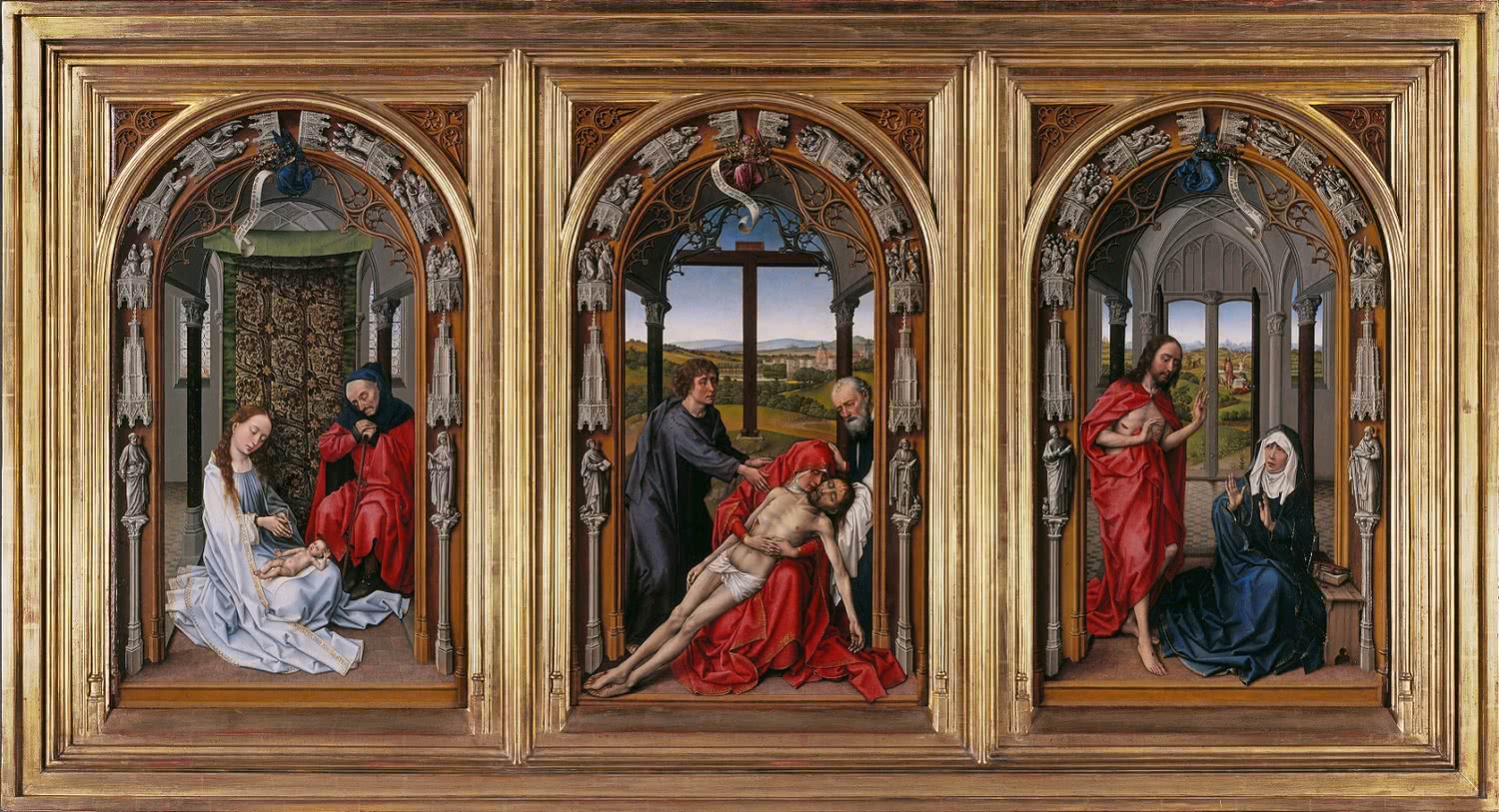
El Museo Nacional del Prado de Madrid acoge desde el 24 de marzo una exposición temporal sobre el pintor flamenco Rogier Van der Weyden. A pesar de que no se conozca ninguna obra firmada por él (hay quien dice que no llegó a firmar ninguna), constan evidencias documentales que demuestran que al menos existen tres obras que pueden atribuírsele: El tríptico de Miraflores, El descendimiento y El calvario. Una de las grandes proezas que ha logrado el museo nacional con esta muestra es la de juntar dichas obras, nunca visto con anterioridad ni siquiera por el propio artista.
Nacido en Tournai (Bélgica) en torno a 1399, Van der Weyden trabajó para numerosos duques y reyes de toda Europa, llegando a ejercer como el pintor oficial de Bruselas durante una época. A pesar de ser coetáneo de grandes artistas como van Eyck, su prestigio fue capaz de traspasar fronteras. En España, el rey Juan II de Castilla y León regalaba a una cartuja de Miraflores (Burgos) recién constituida el Tríptico de Miraflores, que tras vagar por toda Europa desde que fue llevado por los franceses en 1808, regresa brevemente a España con esta exposición. Entre la selección de obras, entroncadas por su carácter religioso, su fidelidad a los detalles o su geometría inequívoca, encontramos El tríptico de los siete sacramentos. En él se observa un predominante Cristo crucificado frente a la celebración simultánea de los siete sacramentos, en una composición marcada por el juego de escalas y tamaños. Supuestamente pintado para la localidad de Poligny, es la primera vez que llega a nuestro país.
Tocado con el don de la fiel representación del mundo que le rodeaba, Rogier destacó por su expresión, por el uso intenso del color y por rozar lo escultórico con la pintura. Los asombrosos detalles de sus obras, al alcance de pocos coetáneos, permiten conocer al espectador la textura de las telas de las prendas retratadas, empaparse con las lágrimas de María Magdalena o distinguir el escarlata que brota de las heridas de un Cristo moribundo. A pesar de este sumo realismo, Van der Weyden era capaz de romper con la razón del espacio y planteaba escenarios inverosímiles donde la geometría se veía supeditada a la expresión. Es el caso de El descendimiento, donde las figuras se retuercen y comprimen en un claustrofóbico espacio y la lógica de la proporción se rompe, alargando o encogiendo las figuras para ganar expresividad y enigmática.
Hace cuatro años el cuadro de El calvario llegó al taller de restauración del Museo del Prado con infinitos roces, grietas, despintados, etc. Después de su paso por la enfermería, la colosal tabla de tres metros y medio de altura está lista para su exhibición, así como el interesantísimo proceso de restauración, ilustrado en video en una de las salas de la exposición, donde puede verse la total y sorprendente renovación que experimentó el cuadro. La muestra, que nunca había conseguido reunirse antes y la cual será muy difícil que se vuelva a anegar, estará en España tan solo hasta el 28 de junio.
Van der Weyden, como bien ha sido descrito por distintos historiadores, fue y aún es el gran maestro de las pasiones. La emoción y la expresión que gritan susurrando sus pinturas hablan de precisión y de detalle, de un espacio impuesto y angustioso y de un tiempo enigmático y, valga la redundancia, atemporal. Pero sobre todo, y quizá sea lo que le vale vasto reconocimiento, hablan de dolor, en las posturas, en la sangre, y en la expresión de las figuras, pero principalmente hablan de dolor en las lágrimas, lloradas por los retratados y, en el caso de Van der Weyden, también por el retrato.

Adriana Cardoso Navarro

 
Van der Weyden’s tears

The Museo del Prado is hosting the temporary exhibition about the Flemish painter, Rogier Van der Weyden., from 24th March. Although there isn´t known any painting signed by him (some claim that he never signed any work), there are clear evidences that show that there is at least three paintings that can be attributed to him: “El Tríptico de Miraflores”, “El Descendimiento” and “El Calvario”. One of the greatest feats of the national museum with this exhibition is to bring together the three works, which not even the artist had ever seen.
Born in Tournai (Belgium) around 1399, Van der Weyden has work for different European Dukes and Kings, being the official painter of Brussels. Although being contemporary of Van Eyck, his prestige was able to cross borders. In Spain, the King Juan II of Castilla y León gave away the “Tríptico de Miraflores”, to the Miraflores Charterhouse. This painting had been stolen by the French army around 1808, then it has travelled around Europe, and it returns to Spain with this exhibition. Between Rogier’s works selection, characterized by his religious nature, his detail precision and his strong geometry, we can found “El Tríptico de los Siete Sacramentos”. This painting has a big crucified Christ, facing the seven sacraments celebration in a composition marked by the different scales of the figures. Supposedly it was painted for Poligny, and it is the first time that it comes to Spain.
Blessed by the gift of the faithful representation of reality, Rogier was notable for his expression ability, for the use of colour and for touch the sculptural with the painting. The amazing details of his paintworks, at reach of only few, allow spectators to feel the texture of the clothes portrayed, to soak up with Mary Magdalene’s tears or discern the scarlet colour of the Christ’s injuries. Despite this maximum realism, Van der Weyden was able to break with de space’s laws and he offered implausible scenarios where geometry was subordinated to expression. This is the case of “El Descendimiento”, where the figures are compressed in a claustrophobic space and the law of proportion is broken, extending and shrinking the figures to win expressiveness and enigmatic.
Four years ago “El Calvario” came to the restoration workshop of the Prado Museum with a lot of frictions, cracks, paint stripping, etc. After having been in the nurse’s office, the huge table (3.5 meters) is ready to the exhibition, and also is possible to see the restoration process in a video, in one of the Prado’s room. The exhibition has never been achieved before and it is very difficult that it could return, but it will be in Spain until June 28th.
Van der Weyden has been described as the master of passions by different historiographers. The emotion and the expression that shout his paints, talk about precision and detail, they talk about a distressing space and about an enigmatic time. But especially, and that can be maybe the main reason of his recognition, they talk about pain. There is pain in the figure’s position, in the blood and in the expression, but mainly there is pain in the tears, mourned by the portrayed and, when we are talking about Van der Weyden, also mourned by the portrait.

Adriana Cardoso Navarro

Review: Pilar Colomo

Jun 2, 2015

B.B. King: Las mismas manos


Riley Ben King, más conocido como B.B. King, falleció el pasado mes en Las Vegas con 89 años. A la espalda se lleva casi setenta años de actividad musical donde protagonizó más de quince mil actuaciones que le valieron el título de “Rey del Blues”. Tras no superar disímiles problemas relacionados con la diabetes, B.B. King fue enterrado en su tierra natal, Mississippi, en una iglesia situada en el delta del río, donde debido a la gran afluencia, la mayor parte de los asistentes tuvo que ver la ceremonia desde fuera. A sus pies, junto al féretro cerrado, se entremezclaban las guitarras con los arreglos florales, sintomático al menos de que la música nunca muere con su autor.

Sus más de 50 discos se han cobrado 15 premios Grammy, la Medalla Nacional de Artes, la Medalla Presidencial de la Libertad, el Premio de Música Polar de la Real Academia Sueca de Música y un largo etcétera. En 1987 entró en el Salón de la Fama del Rock and Roll, e independientemente donde se busque, se inquiera, o se lea, aparece en todos los rankings entre los diez mejores guitarristas de la historia.
Por no romper los clichés, los orígenes de este bluesman se encuentran cerca de una plantación de algodón en Itta Bena (Mississippi). Tras ejercer como pertinente músico callejero emigró a Memphis en busca de una mejor carrera musical. Entre actuaciones radiofónicas y conciertos por los distintos locales de la capital, ocurrió uno de los acontecimientos que sin duda marcaría sin igual su trayectoria profesional. Actuando en Arkansas le sorprendió una pelea entre dos espectadores que terminó por prender fuego al local. A pesar de conseguir salir del mismo, B.B. King no dudó en volver a atravesar las llamas para rescatar su Gibson acústica de apenas 30 dólares. Aquella guitarra, así como todas las que la siguieron, fueron bautizadas desde aquel día con el nombre de Lucille, al ser una mujer con dicho nombre la causante del enfrentamiento en el local.
Podría decirse que las dos grandes gestas de este Rey han sido mantenerse en la cresta durante más de medio siglo e influir notablemente en la carrera de muchos otros grandes músicos. Eric Clapton, Phil Collins, Zucchero, Raimundo Amador, Joe Bonamassa, U2 y muchos otros se dejaron inspirar, colaboraron y aprendieron durante años de la música de B.B. King. La emoción por su pérdida se observa en los diferentes mensajes de despedida que el panorama artístico le ha dedicado en las postremas semanas.
Desaparece así uno de los últimos grilletes de la época de afirmación y auge de la música negra norteamericana. Aunque fundamental en toda discografía por su larguísima carrera, B.B. King siempre ha estado un escalón por debajo de músicos como Hendrix o Allman, lo cual podría traducirse como la suerte o la desgracia del músico que no muere joven. A pesar de ello el prodigio de sus manos no se olvida fácilmente, y menos aún al pararnos a pensar, como se destacó en su funeral, que fueron las manos de un Rey las que un día recogían algodón. Las mismas manos que hicieron vibrar a Lucille para el disfrute de todos.

Adriana Cardoso Navarro

B.B. King: The same hands

Riley Ben King, best known as B.B. King, died at the age of 89 in Las Vegas. Behind him he leaves almost 70 years of musical activity and more than 15,000 performances that allowed him to obtain the title of « the king of blues ». After not getting over different diabetes diseases, B.B. King was buried in a church on the river delta in Mississippi, his original homeland. Given the large number of people, most of the attendants had to watch the ceremony from the outside. Near the coffin were different guitars and floral arrangements, a symptom of « the music doesn’t die with the author ».

His more than 50-records have won 15 Grammy Awards, the National Medal of Arts, the Presidential Medal of Freedom, the Polar Music Award by the Swedish Royal Academy, etc. In 1987 he was inducted into the Rock and Roll Hall of Fame and independently where we look for, he appears among the top ten of best guitar players in the world.

The origins of this bluesman were near a cotton plantation in Itta Bena (Mississippi). After working as a street-musician he emigrated to Memphis looking for a better musical career. Between radio transmissions and different shows in the city bars, a very important event took place. In a concert in Arkansas two spectators started to fight and they finished setting the bar on fire. B.B. King re-entered into the bar to rescue his Gibson acoustic guitar that cost just 30 dollars. This guitar and all his next ones were named Lucille, for being the name of the woman who had provoked the fight.

The two big feats of this King have been to keep himself on the summit for more than a half a century, and to influence other musicians’ career. Eric Clapton, Phil Collins, Zucchero, Raimundo Amador, Joe Bonamassa, U2 and many others collaborated and learned from B.B. King’s music. The emotion can be appreciated in the different farewell messages that other musicians have dedicated to him.

One of the last pieces of the North American black music´s boom period disappears. He was a very important musician for his long career, but B.B. King has always been below other artists like Hendrix or Allman, than can be translated as the luck or the misfortune of the ones who don’t die young. Despite this, his hands won´t be easy to forget, and specially if we think that they were the hands of a King which once were picking cotton. The same hands that made Lucille vibrate for all of us.

Adriana Cardoso Navarro

Review: Pilar Colomo

May 28, 2015

LABORATORIO CULTURAL MÉXICO-ESPAÑA


El pasado jueves 21 de mayo asistimos al Laboratorio Cultural México-España, el cual versaba sobre el tema 189 maneras de hacer cine. El objetivo es acercar dos industrias cinematográficas que, aún distantes una de la otra, comparten varios puntos de vista. Nosotros tuvimos la ocasión de asistir al último encuentro del día: el coloquio sobre "El arte de la guerra, las batallas del director" que contó con la participación del director español Alex de la Iglesia, conocido por películas como El día de la bestia, La comunidad o Balada triste de trompeta, productor de Musarañas y Los héroes del mal y ex-presidente de la Academia de Cine española; y el director mexicano Roberto Sneider, director de Arráncame la vida y Dos crímenes y productor de Frida. La moderadora del encuentro fue Yolanda Flores, periodista de Radio Nacional de España.
¿Qué tienen en común estos dos directores? Salma Hayek. Sneider conoció a la actriz en Frida y De la Iglesia años antes en México, mientras rodaba Perdita Durango, una de las películas con mayor nivel de producción que ha realizado. Asimismo, colaboró con Hayek una década después en La chispa de la vida. Sin duda, De la Iglesia se considera un amante tanto del cine mexicano, como del cine producido en México y dirigido por españoles, como fue el caso de Luis Buñuel. Sneider, por su parte, ha tenido la ocasión no de trabajar en España pero sí con profesionales españoles, como el director de fotografía Javier Aguirresarobe.
Sneider nos habló acerca de su pasión por la adaptación de novelas; de hecho, tres de sus películas son adaptaciones de la literatura hispanoamericana. Mostró cierta reticencia ante los guionistas, quienes considera que no pulen su trabajo en gran parte porque este no les pertenece, al contrario que un novelista, quien, como afirmó Alex de la Iglesia, no tiene intermediarios: se muestra como es ante el lector. El guionista tiene que ser más que nada eficaz, ya que todo el mundo puede meter mano a su trabajo y todos se creen con derecho a opinar sobre él. Todo el mundo quiere violar el guión y hacerlo suyo, en palabras del director español, lo cual suscita una serie de desacuerdos y quebraderos de cabeza que a veces convierten lo que debería ser un trabajo placentero en un trabajo ingrato.

El punto de vista pesimista e irónico del director español (muy propio de sus películas) fue dulcificado por el director mexicano quien, pese a dar la razón a su compañero, imprimió ciertas esperanzas entre el público. Según él, el cine es constante reinvención: desde la etapa de escritura a la postproducción, y a veces se pasa mal y se sufre y otras se disfruta al máximo.
Pero si en algo coincidieron ambos es en la falta de tiempo, en especial Alex de la Iglesia, quien describió el rodaje como un juego en el que debes ceñirte a unos planes y controlar los horarios en todo momento. En su caso, sus películas se caracterizan por tener secuencias de acción delirantes y de gran complejidad, lo cual provoca que la falta de tiempo se resienta aún más.
En cuanto al tema de autoría, Sneider afirmó que el trabajo de un director consiste en intentar reproducir con la mayor exactitud aquello que tenía en la cabeza desde un primer momento, apunte con el cual coincidió De la Iglesia; según el español: "una cosa es lo que quieres hacer, lo que puedes hacer y lo que te encuentras".
El encuentro llegó a su fin con una breve reflexión acerca de la necesidad de colaboración entre los países en cuanto a creación cinematográfica y la relevancia de eventos como los Premios Platino para unificar las distintas industrias. Asimismo, los directores aconsejaron a los futuros cineastas lo que ya todos imaginamos: que deben rodar, rodar y rodar.

Diego Martín.

CULTURAL LABORATORY MEXICO-SPAIN

On Thursday May 21st we attended the Cultural Laboratory Mexico-Spain, which dealt with the topic 189 ways of making films. The aim is to bring closer two film industries which, although distant from each other, share many views. We had the opportunity to attend the last meeting of the day: the conference on "The Art of War, the battles of the director" which was attended by Spanish director Alex de la Iglesia, known for films such as “The Day of the Beast”, “Common Wealth” or “The Last Circus”, producer of “Shrew´s Nest” and “Los Héroes del Mal” and former president of the Spanish Film Academy; and Mexican director Roberto Sneider, director of “Tear This Heart Out” and “Dos Crímenes” and producer of “Frida”. The moderator of the meeting was Yolanda Flores, a journalist for National Radio of Spain.

What do these two directors have in common? Salma Hayek. Sneider met the actress in “Frida” and De la Iglesia years before in Mexico, while filming “Dance With the Devil”, one of the films with higher production he has done. He also collaborated with Hayek a decade later in “As Luck Would Have It”. Certainly, De la Iglesia is considered a lover both of Mexican cinema, as well as cinema produced in Mexico and directed by Spaniards, as was the case of Luis Buñuel. Sneider, meanwhile, has had the opportunity not to work in Spain, but to work with Spanish professionals, as cinematographer Javier Aguirresarobe.

Sneider told us about his passion for the adaptation of novels; in fact, three of his films are adaptations of South American literature. He showed reluctance to the script writers, who, in his opinion, do not polish their work largely because this is not their own, unlike a novelist, who, as Alex de la Iglesia said, does not have any intermediaries: he reveals himself to the reader. The script writer has to be more effective than anything else, because everyone can get their hands on his work and all feel entitled to review it. Everybody wants to violate the script and make it his own, in the words of the Spanish director, raising a series of disagreements and headaches that sometimes turn what should be a pleasant job into a thankless job.

The pessimistic and ironic view of the Spanish director (very typical of his films) was softened by the Mexican director who, in spite of giving in to his companion, spread some hope among the public. According to him, cinema is constant reinvention: from the writing stage to the post production, and sometimes it goes wrong and you suffer and sometimes you enjoy to the fullest.

But if they both agreed on something that is lack of time, especially Alex de la Iglesia, who described shooting as a game where you have to stick to a plan and control schedule at all times. In his case, his films are characterized by delirious action sequences of great complexity, which causes the lack of time to be a more difficult situation.

On the issue of authorship, Sneider said that the job of a director is to try to play as precisely what he had in mind from the outset, opinion with which De la Iglesia agreed; according to the Spaniard: "One thing is what you want to do, what you can do and what you find afterwards."

The meeting ended with a brief reflection on the need for cooperation between countries in terms of filmmaking and the importance of events like the Platinum Awards to unify the different industries. The directors also advised future filmmakers what we already imagine: they must shoot, shoot and shoot.

Diego Martin.

Review: Pilar Colomo.